reflection:
Writing in Your Native Language
Naomi Rose, Book Developer & Creative Midwife
WRITING IN YOUR NATIVE LANGUAGE:
It may not be what you think it is. . . .
Do you remember learning the language you speak? All children are born with the potential to speak any language at all — from highly structured grammatical languages to clicks that Westerners couldn’t easily duplicate — but from the great width of this potential, the sounds narrow down to emulate what the parents and other adults in the vicinity speak.
But what about the world we inhabited before learning our “native” language? What about our truly native language? How much of that has had room to persist and be known and made use of?
I once knew a woman who had been born in France, and still spoke the language with her family. “Do you dream in French?” someone asked her once, in my presence. “Oh yes,” the woman answered readily. “Quite often.”
Do you remember learning the language you speak? It was probably so long ago, how could you? And yet we know that all children are born with the potential to speak any language at all — from highly structured grammatical languages to clicks that Westerners couldn’t easily duplicate — but from the great width of this potential, the sounds narrow down to emulate what the parents and other adults in the vicinity speak. I remember the miracle of watching my young son, long ago, test out those sounds he heard us speak until some semblance came out of his own mouth. The combination of his efforts and our delighted praise (“You said ‘cat!’ You did!”) served to reinforce his determination to belong to this small but crucial world of the language we spoke. (That he would grow up to be a natural amateur linguist, who could tutor me on the correct pronunciation of a Croatian word, was nothing I could see coming at that juncture.)
But what about the world we inhabited before learning our “native” language? What about our truly native language? How much of that has had room to persist and be known and made use of, given us access into portals we may long for, when what we have been conditioned to learn — as adults as well as from when we were children — has so influenced us and filled our inner screen?
If our native language is not actually words in a certain distinct tongue but a way of seeing and knowing, can we remember that it is still there? Can we soften our hard-edged intellects into a more porous way of perceiving that can bring something precious back to us?
I was reading a memoir where the author spoke of seeing numbers and letters as colors, as a child, and that she was able to come up with the “right answers” (the word correctly decoded, the addition problem correctly solved) by placing the colors that in her mind adhered to the individual letters and numbers and putting them together. So a red-colored “1” and a blue-colored “2” could be brought to a sum by her visualizing purple for “3.” It’s not that this internal activity was how everyone did it (and her ability faded, in the face of more cognitive teachings). But before there was conceptualization, there was some kind of direct experience that came from somewhere other than our conditioning, other than the influences that knocked out the hundreds of other languages we could have ended up speaking before we were (even lovingly) influenced to speak just this one.
This musing is not meant to be about languages spoken on earth, so much as the capacity for direct knowing that each of us carries. But because this essentially non-verbal capacity isn’t given room or encouragement to persist as we grow older, it most often fades into the background of memory, until it becomes invisible to us.
But there are times when we long for the invisible.
When the press of the world loosens its grip for a time, even a few moments, the invisible has more room to give itself back to us. A moment of color when our eyes are closed in sunlight can stun us with the world inside that we don’t remember. Suddenly, something — the optic nerve, or the spirit coming through our usual preoccupations — brings us news of another place that we have not thought about for years, if ever consciously. And yet here it is, so very available.
I call myself a Book Developer & Creative Midwife. The 'development' part comes from the process (more rare in these digital days) of a photograph developing in a darkroom,showing the image’s evolution from dark featurelessness into form. This development is what is important. Otherwise, writing a book is just a task. Yet as I’ve looked into my heart and soul, lately, while recuperating from something as ordinary and yet stopping-the-usual as a cold, I’m understanding that “having written” is far less important than having the emergent experience of our native language that can show up in the course of this developing book-writing. That is, when our writing is a pathway into our native language — including the time before any words were even required, because so much gave itself to us directly and intimately — then this process becomes a way to speak to what can’t really be spoken. Can light be transmitted through words? Perhaps it can, if the light is actually experienced as we write, so that the words don’t just hang in the air but instead adhere to the molecules of light through our opening into that light.
I have written a fair amount about my childhood memories of light. They are what connect me to the essential being I was before all the adaptive languages came in. Light must be my native language (most likely the native language of all of us), because I have written about it more than once.
Here is a tidbit from a story I once wrote called “Postcards from the Lost World.”
All through my childhood, I had experiences of what I later came to read of as "rips in the veil," the parting of a filmy inner curtain that revealed the other world, the world later described by poets and saints and mystics as "Paradise," or "the lost world." Perhaps because my own parents were dreamers, and for a long time fed me on their dreams, I felt more comfortable in the dream world than in the strange, often barbaric and competitive tussle of what was called "real life."
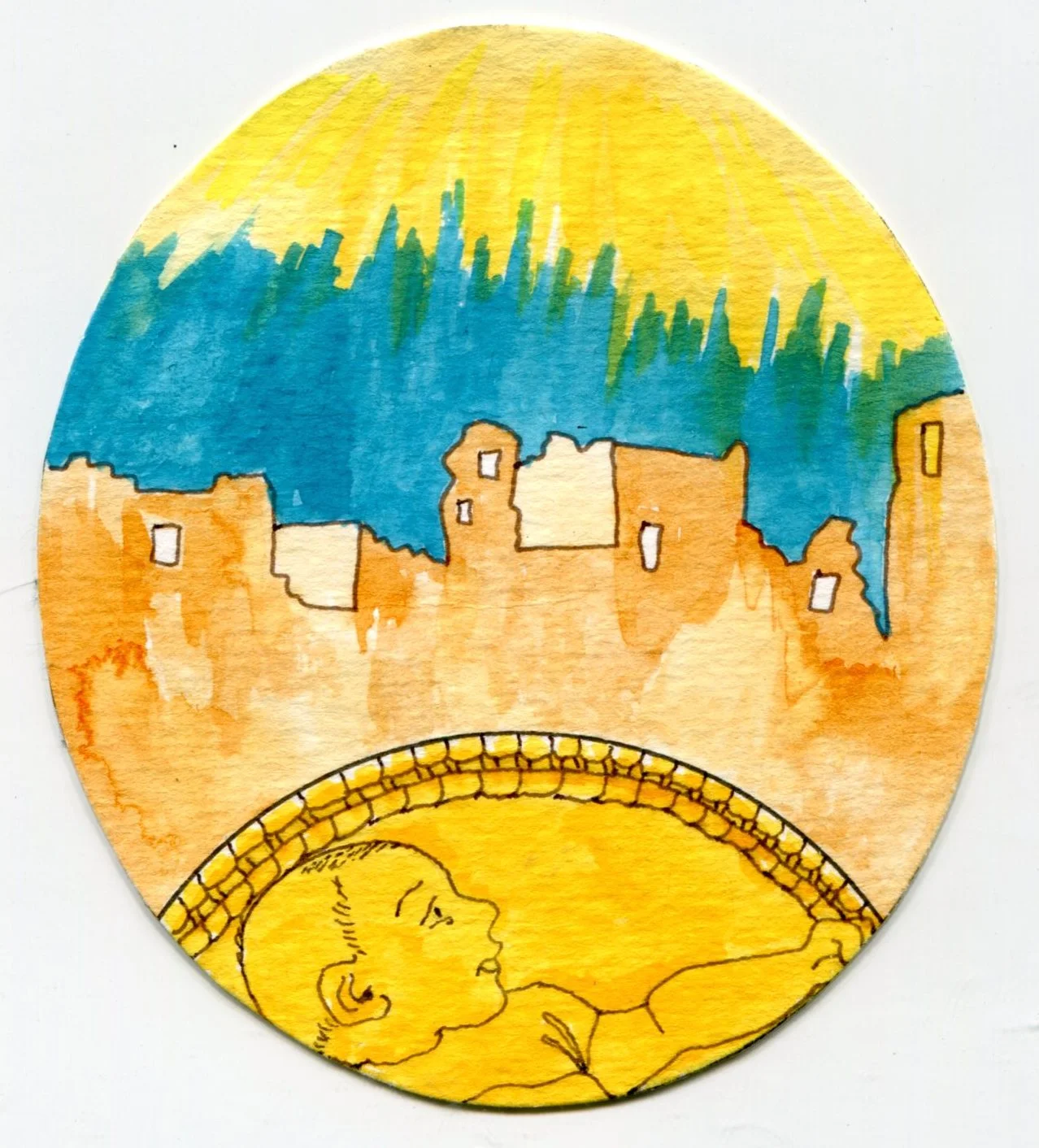
While I was young, and my heart quite open, these rips came as great gifts, like friends from long ago who lived closer in the heart than anyone I knew in person. I could never tell what would occasion these remembrances; only that when they came, there was a great swelling of joy, a recall of something very important, more important than whatever I was caught up in at the moment — and then, when they mysteriously faded away, I felt an enormous loss, a panic to be suddenly stranded here, in this body, in this bright, football-playing world where I was somehow to toughen myself that I too might, in my own way, bash my padded shoulders, my helmeted head against the world that would call me out onto some barren playing field and blow a piercing whistle and I would have to enter the fray.
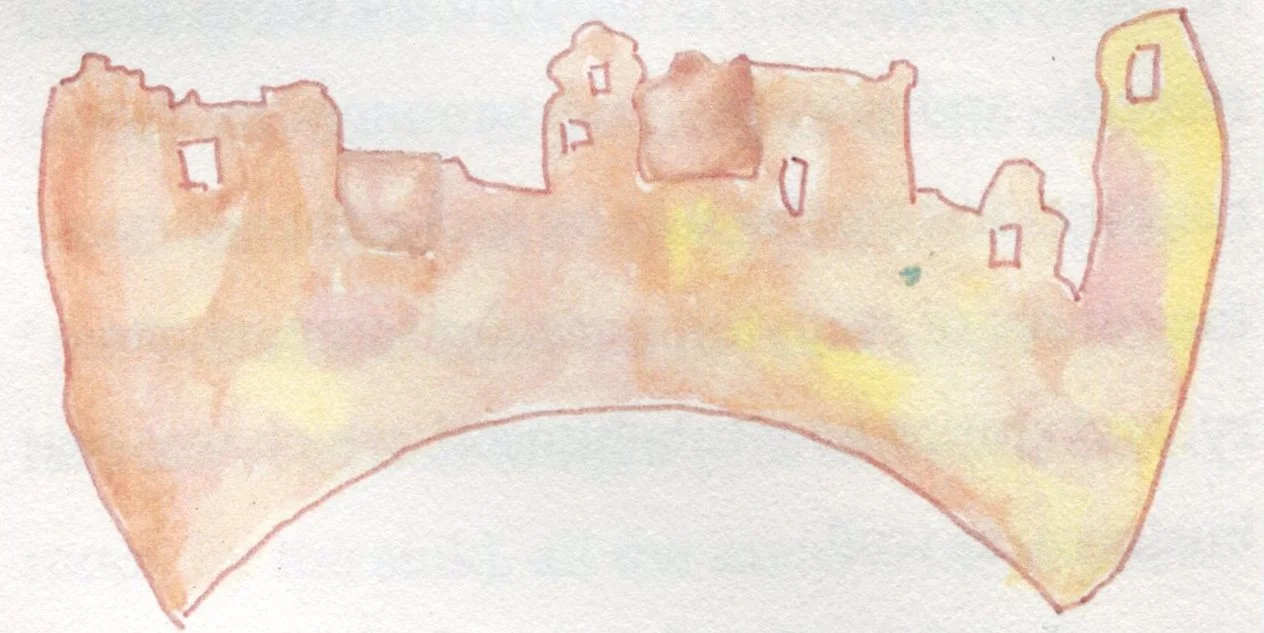
One recurrent scene came to me in the crib, and then again later in life, in the midst of an ordinary conversation or during a hard and despairing time. And this scene flooded me with a great golden hope beyond questioning, let loose unbridled certain joy and cellular knowledge of what I was and what for and why. It was simply this: a great cliff seen in sunlight, in the afternoon’s golden light, its massive outcrops copper in the light, the light the gold of just turning, just moving into sunset. And above the copper-glinting cliff, a sky of turquoise blue. In my crib I lay looking at this old friend, this call to home, this landscape that moored me to something I could not ever name, but which I knew with my heart’s beat and life’s blood, and had always.

Although this scene came and went, always at its own bidding, never mine, its golden light followed me, invisible, through the gloom of later years. And something of its echo, as a felt sense rather than a vision, would be behind me or within me during precious or trying moments: walking barefoot, as a young child, on moist grass, wearing a sundress of yellow, with the yellow morning sun warm on my bare shoulders, bending down to smell a Black-eyed Susan, its deep dark center cupped by bright yellow petals. The cliff’s untold story stayed with me, invisibly, bringing the natural world into delicious, trustworthy focus, making it possible for me to yield myself to whatever, whoever of love was there: a flower, a grasshopper, Marais and Miranda singing deeply and sweetly from my record player, my velvet-soft mother’s grained, perfumed arms, my oversober father’s freshly shaven face. I was visitor, then, to this world, but one with unexpected postcards from home.
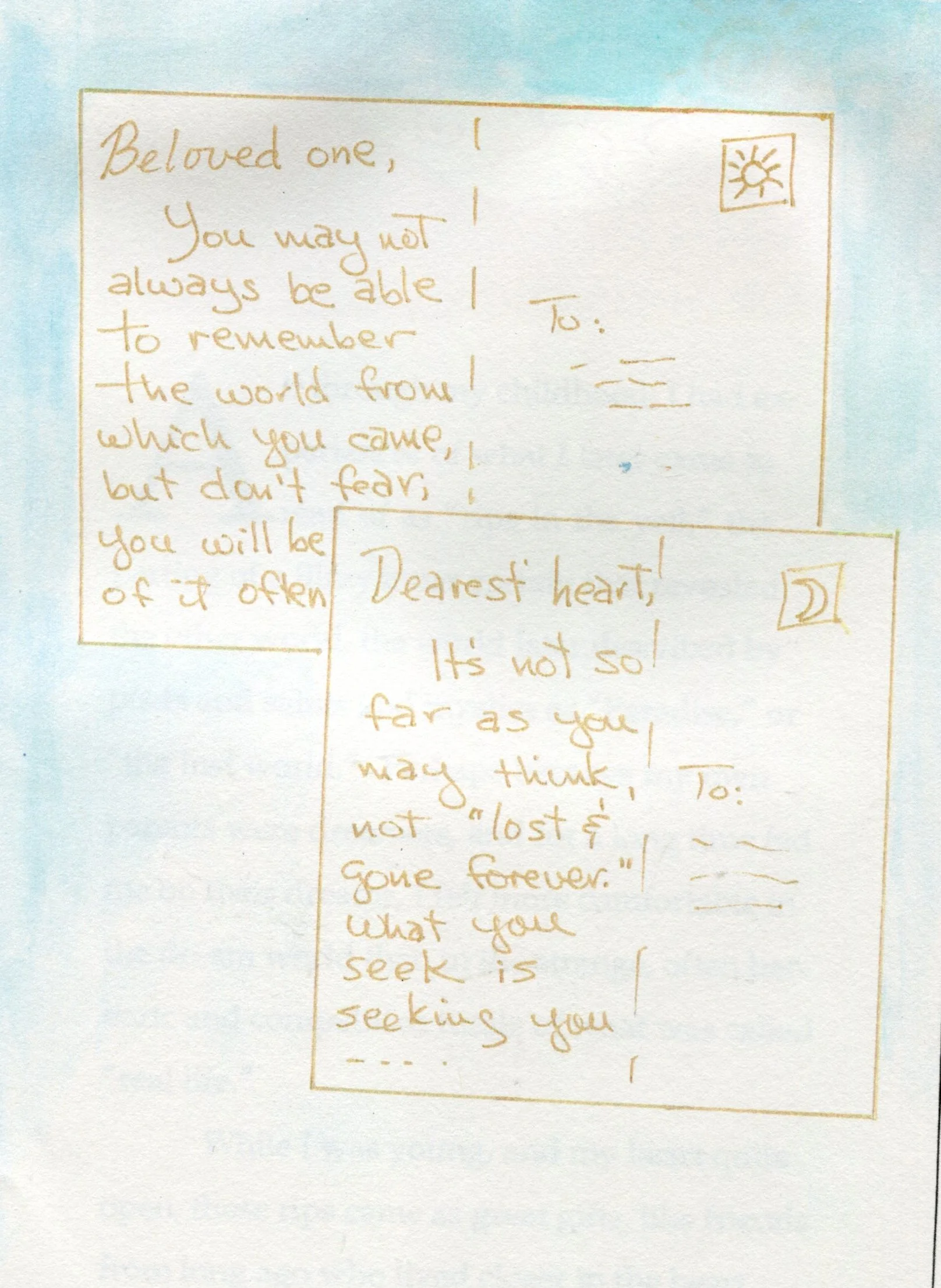
I think we all, at some time, receive a kind of “postcard” from a world that we deem lost — but only to our cognitive, getting-things-done mind.
What if the desire to follow such a missive back to its source were to come to you, and you were to give it room inside you?
What if the direct experience moved your words into motion, rather than your starting with the words.
Wouldn’t you then remember something that moored you to what’s real in you — and made it possible for you to share with others in some written form, as I have done with you here?
does something in you long to write from your own native language — that deeper place of knowing?
If this stirs something in you, I'd be glad to explore it with you together.
You're warmly invited to a free 30-minute Discovery Call.
This is the end of the reflection, “Writing in Your Native Language.”
To return to the main REFLECTIONS page, click the link.
